Doctor SEO guide
SEO for doctors: how to get found by patients who need you
Patients search by symptom, condition, treatment or by your name. Your site has to answer all four, and prove you are who you say you are.
4 min read · By the Liftup team in Pune



350+businesses served
8countries
7+years















In short
SEO for doctors starts with proof of expertise: a profile page for each clinician with verifiable credentials, condition and treatment pages reviewed by a named doctor, and a verified Google Business Profile per location. Add easy booking and keep patient data out of analytics. Rankings follow trust, so build trust signals first.
Rather have it done for you? See our SEO service, from $1,500.
On this page 6 sections
Why health searches are judged more strictly
Google treats health pages as Your Money or Your Life content. Its quality guidelines ask for first-hand experience, expertise and trust, and a page about a medical condition is held to a higher standard than a page about a hobby. A generic article scraped from other sites has little chance against a page written or reviewed by a named physician.
That is an advantage for a real doctor. You have what content farms lack: credentials, clinical experience and a licence that can be checked. The job is to show it on the page instead of leaving it in a filing cabinet.
The four ways patients search
| Search type | Example phrasing | Page that should answer it |
|---|---|---|
| Symptom | why do I feel tired after eating | Symptom guide that explains causes and when to see a doctor |
| Condition | type 2 diabetes management | Condition page: what it is, how it is diagnosed, how you treat it |
| Procedure or service | thyroid ultrasound | Service page: what happens, preparation, recovery, who it suits |
| Doctor or place | Dr Name cardiologist, endocrinologist near me | Doctor profile and the Google Business Profile for that location |
Most new patients who are ready to book use the last two. Symptom searches bring readers earlier in their journey. You do not need to cover every symptom. Choose the conditions you actually treat.
Rather have it done for you?Talk to a person now, or ask for a fixed quote. We reply within one working day.
Steps to build a doctor-led site
- Give every clinician a profile pageFull name as it appears on the register, specialty, qualifications, registration body and number where your regulator allows it, languages, hospitals or clinics, and a photo. Link to the page from every article the doctor reviewed.
- Write condition and procedure pages in plain languageAnswer what it is, who gets it, how it is diagnosed, treatment options, and when to seek urgent care. Add a reviewed by line with the doctor's name and the review date.
- Claim and complete the Google Business ProfileUse the exact practice name, a consistent address and phone number, correct categories such as the specialty, opening hours and a booking link. Add services and photos of the premises.
- Make booking obvious on mobileA tap-to-call button and an online booking link on every page. Most patients search from a phone.
- Ask for reviews the right waySend a short message after a visit with a link to your profile. Reply to every review without confirming that the reviewer was a patient.
- Track enquiries, not just visitsCount calls, booking requests and form submissions by landing page, using methods that do not record health details.
Rules that change what you can publish
Check your own regulator and a compliance adviser before you publish. These are examples of where rules differ.
- United States: patient information tied to a condition can be protected health information. Keep it out of analytics events, ad pixels and form tools that are not set up for it.
- United Kingdom and EU: health data is special category data under GDPR, so cookie consent and processor contracts need extra care.
- Australia: advertising by registered practitioners cannot use testimonials, which affects how you display reviews on your own site.
- Everywhere: do not promise a cure or an outcome, and do not claim a specialty you are not registered in.
Mistakes that weaken a doctor's site
- Doctor pages that are two lines long with no credentials.
- Unreviewed AI-written medical text. A mistake there is a patient safety problem, not only an SEO problem.
- Name variations across directories, such as Dr, MD and the full name used differently, which makes the listings look like different people.
- A booking flow that needs a phone call during office hours only.
- Publishing a page on every disease instead of the ones you treat.
A site we built for a clinic, and what we claim about it
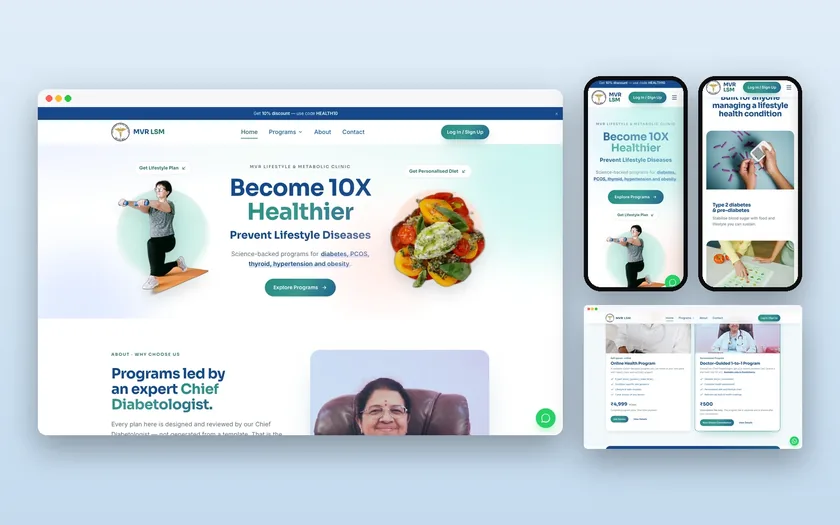
Liftup built the website for MVR LSM Clinic, a lifestyle and metabolic health clinic whose Chief Diabetologist designs programs for diabetes, PCOS, thyroid, hypertension and weight. The site puts the doctor and the doctor-designed approach first, helps visitors choose between a self-paced online program and a one-to-one consultation, and lets them sign up online. You can read it on the MVR LSM Clinic case study. It was a website project, and we are not citing search results for it.
If you want an audit of your current pages for trust signals, structure and local visibility, see our healthcare SEO services and request a fixed quote on the contact page. Our approach is technical fixes first, then content and links, reported from your own Search Console.
Sources: Google Search Central: creating helpful content.
Updated 20 November 2026

Questions, answered
Something else on your mind? Ask us directly or WhatsApp us. We reply within one working day.
Do doctors need SEO if patients come by referral?
Can I use patient testimonials on my website?
How many pages does a doctor's website need?
Is a Google Business Profile enough?
Can I use AI to write medical pages?
Keep exploring
SEO for healthcare: earning trust before you ask for a booking
Health searches are held to a higher standard than most. Google treats them as pages that can affect a person's wellbeing, so evidence, authorship…
WorkA Patient-Friendly Website for MVR LSM Clinic
MVR LSM Clinic is a lifestyle and metabolic health clinic whose Chief Diabetologist designs programs for diabetes, PCOS, thyroid, hypertension and…
See how Google and AI see your site.
A free SEO and AI visibility check with the top fixes, within one working day. No obligation.