Ecommerce pricing
How much does an ecommerce website cost in 2026?
An online store is priced by what it has to do, not by how many pages it has. This page lists the line items and shows how to count them before you ask for a quote.
3 min read · By the Liftup team in Pune




How much would this cost us?
A fixed quote within one working day.
350+businesses served
8countries
7+years















In short
Clutch reports that web development projects typically come in under $10,000, with an average of $66,499. Ecommerce sits across that whole spread. A theme-based store with a small catalog is at the low end. Custom checkout, large catalogs and system integrations push toward the average and past it.
Rather have it done for you? See our ecommerce development service, from $1,500.
On this page 7 sections
What the market data says
The Clutch web developer pricing guide lists two numbers: web projects typically under $10,000, and an average of $66,499. The average is almost seven times the typical ceiling. That is a sign that a minority of very large builds, such as multi-region stores with custom back-end work, pull the mean up.
Clutch's figures cover web projects in general, not stores alone, so read them as the frame, not as a price for your shop. Your own number comes from the line items below.
Six line items that set an ecommerce quote
| Line item | Question to answer | Effort moves with |
|---|---|---|
| Platform and theme | Hosted platform with a theme, or custom front end? | How far design departs from the theme |
| Catalog | How many products, variants and collections? | Variant logic, bulk import, data cleanup |
| Checkout and payments | Which gateways, currencies and tax rules? | Markets served, subscriptions, local methods |
| Shipping | Flat rate, zones, live carrier rates, pickup? | Number of carriers and rules |
| Integrations | Inventory, accounting, ERP, email, reviews? | Number of systems and data direction |
| Content and SEO | Who writes product copy and category pages? | Volume, migration of old URLs |
Ask every vendor to quote against the same six lines. When one quote is cheaper, you can see which line it has quietly dropped.
Free · no obligation
Get a free SEO and AI visibility check of your site
We look at how Google and AI tools like ChatGPT see your site and send you the top fixes, within one working day.
Request received
Thanks. Your free check is in the queue.
We will send the top fixes on WhatsApp or email within one working day.
A worked scoping example: 200 products
Say you sell 200 products, 60 of them with size and color variants, to customers in one country, using one payment gateway and one shipping carrier. Here is how the effort breaks down.
- Catalog importClean your product data into a spreadsheet: titles, descriptions, images, variant options, SKUs. The cleanup usually takes longer than the import.
- Templates, not pagesYou need a home page, collection page, product page, cart, checkout styling, account pages and a handful of content pages. That is the design scope, however many products you have.
- Payments and taxOne gateway and one tax region is a configuration job. Adding a second country adds tax, currency and shipping rules.
- ShippingOne carrier with flat or weight-based rates is quick. Live rates from several carriers take integration time.
- Launch checksTest orders, email notifications, analytics events, redirects from old URLs and mobile checkout.
Change one input and the quote moves. Add a second country and the payments, tax and shipping rows each grow. Triple the variants and the import and testing rows grow.
Platform choice changes where the money goes
| Path | Build effort | Running costs | Fits |
|---|---|---|---|
| Hosted platform such as Shopify | Lower, theme and settings | Platform plan plus apps, billed by the platform | Most small and mid-size stores |
| WordPress with WooCommerce | Medium, more to configure and secure | Hosting, plugins, upkeep | Content-led stores, custom needs |
| Headless with a custom front end | Highest, two systems to build | Hosting for both, developer time | Complex catalogs, speed-critical stores |
Platform fees and app subscriptions are paid to third parties, not to the agency. They do not appear in a build quote, so ask for a list of them with the proposal. Our Shopify vs WooCommerce comparison goes through the trade-offs.
Real stores we have built
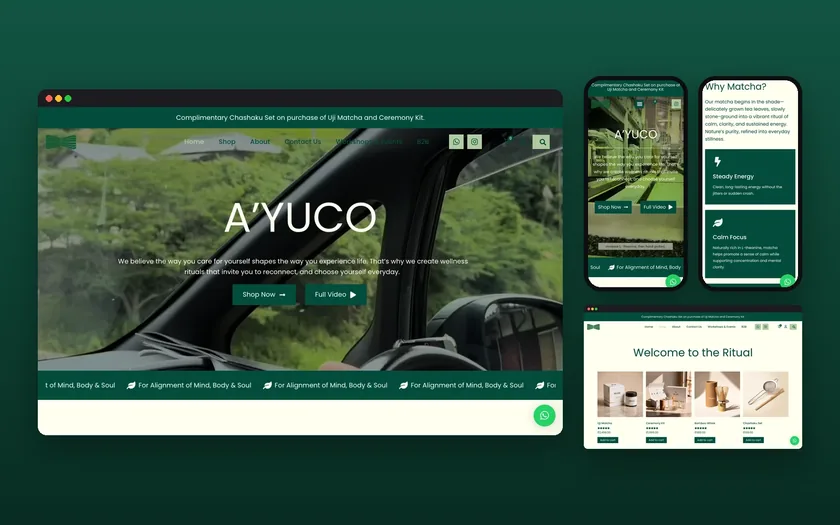
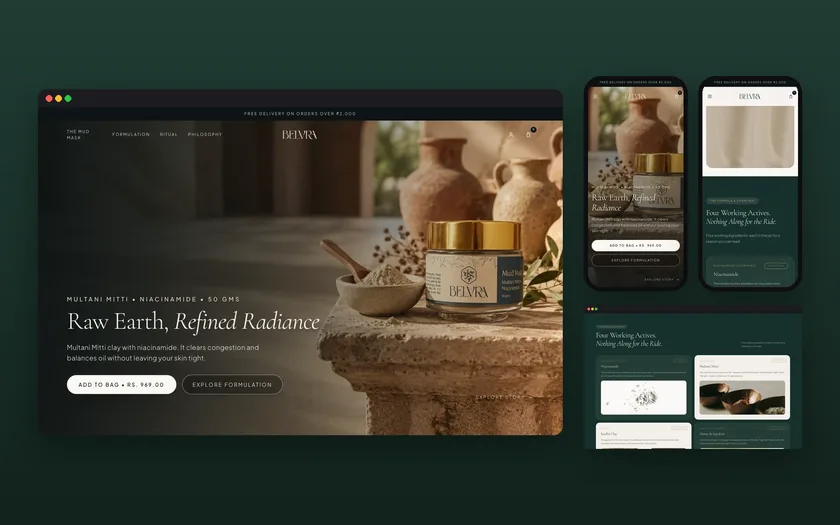
Belvra launched with a single product, so its Shopify store put the work into explaining the formula and a short path to buy. Blume is a USA skincare brand where we worked on the ecommerce experience. A'YUCO sells matcha, whisks and ceremony kits on WordPress and WooCommerce, with room for workshops and B2B orders. Each has a different catalog shape and a different platform, which is why their line items differ.
Costs people forget
- Product photography and copy, if your supplier does not provide them.
- Apps and plugins that bill monthly, such as reviews, subscriptions and search.
- Payment processing fees, which are a percentage of sales and sit outside the build.
- Ongoing maintenance for updates, security and fixes.
- Search work after launch. A new store has no history, so ecommerce SEO is a separate line.
How we quote
We do not publish prices for our own work. On a short call we count the six lines with you, then send a fixed quote. See ecommerce solutions or contact us to start.
Sources: Clutch: web developer pricing guide.
Updated 20 November 2026
Questions, answered
Something else on your mind? Ask us directly or WhatsApp us. We reply within one working day.
What is the cheapest way to launch an online store?
Why does the Clutch average look so high?
Should I build custom or use a theme?
Does the quote include product data entry?
Can I start small and add features later?
Keep exploring
How much does a Shopify store cost in 2026?
Part of the cost of a Shopify store goes to Shopify and its app makers, part to whoever builds it. Keeping the two apart is the key to reading any…
ServiceEcommerce website development for brands that sell online
We design and build online stores that explain the product, make buying simple and stay easy to run after launch.
ComparisonShopify vs WooCommerce: which to choose in 2026
Shopify is a service you rent. WooCommerce is software you run. Nearly every difference follows from that.
Rather talk it through?
A free 30-minute call with a specialist. Straight answers, and a fixed quote if you want one.