By business type
How to make your business rank higher on Google
A plumber, a Shopify store and a B2B software firm all want to rank, but they compete in different parts of Google. Start with the part where your customers actually look.
3 min read · By the Liftup team in Pune




350+businesses served
8countries
7+years















In short
To make your business rank higher on Google, first identify where your customers search: the map pack for local businesses, product results for online stores, or standard results for B2B and expert services. Then put effort there: a verified Business Profile for local firms, product and category pages for stores, and detailed pages for expert services.
Rather have it done for you? See our SEO service, from $1,500.
On this page 5 sections
Google has several places to rank, and you need the right one
A search result page is not one list. For a search with local intent, Google shows a map with three businesses, then web results. For a product search it may show shopping results. For a research search it shows articles and guides. Ranking higher starts with knowing which of these a customer sees when they look for what you sell.
Search your main service phrase in a private window, from the town you serve. Note what appears first: a map, ads, shopping, articles or service pages. The table links that observation to a plan.
| Business type | Where customers see you | Work that matters most | Work that matters least at first |
|---|---|---|---|
| Shop or clinic with a premises | Map pack and local organic results | Google Business Profile, reviews, location page, consistent listings | National link building |
| Service-area firm (plumber, cleaner, electrician) | Map pack for nearby searches, plus service-page results | Profile with service areas, service pages per job type, review flow | Blog volume |
| Online store | Shopping results, category and product pages | Product data, category pages, speed, structured data, reviews | Map listings |
| B2B or SaaS company | Informational results and comparisons | Topic pages, comparison and use-case pages, links from industry sites | Local profile work |
| Professional practice (lawyer, accountant, doctor) | Map pack plus expert content | Profile, service pages with named expertise, trust signals, review handling | Mass location pages |
Step 1: confirm the basics for every type
- Your site loads on a phone in a few seconds and shows the business name, what you do, where, and how to contact you in the first screen.
- Each main service or product has its own page, not a single list on the homepage.
- The pages are indexed, which you can check in Search Console.
- Your business name, address and phone appear exactly the same everywhere.
If any of these is missing, fix it before anything in the table. For a step-by-step check of the site, see how to improve the SEO of your website.
Rather have it done for you?Talk to a person now, or ask for a fixed quote. We reply within one working day.
Step 2: do the work that fits your row
Local premises and service-area businesses: claim and complete the Business Profile, then collect reviews steadily. Build one page per service and, where you have a real presence, one per location. Do not publish 50 near-identical town pages. Google's spam policies describe doorway pages, and thin location pages can fall into that group, so they rarely help.
Online stores: category pages are usually the biggest opportunity because they match broad searches. Write real descriptions for them, keep product pages unique, and add product structured data so price and availability can show. See ecommerce SEO for the work involved.
B2B and SaaS: buyers research for weeks. Cover the questions at each stage: what the problem is, which approaches exist, how to compare vendors and how it works in practice. B2B SEO and SaaS SEO describe how this is planned.
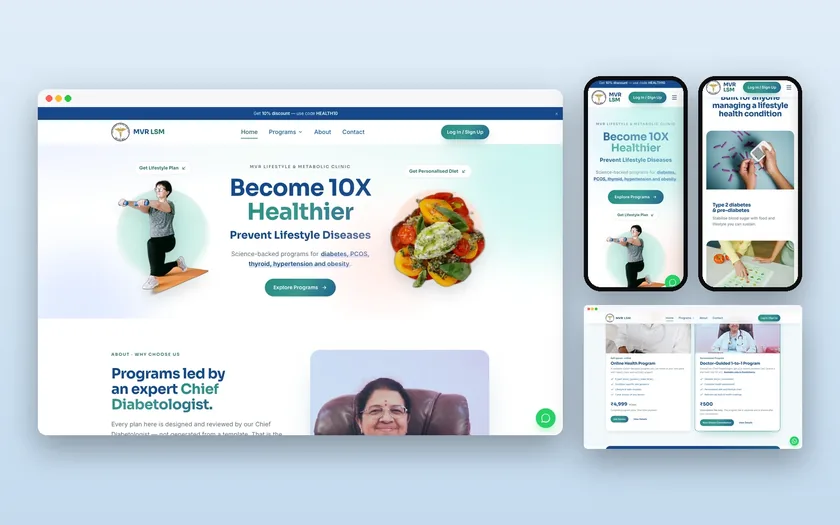
Professional practices: trust is the barrier. Show who the people are, their qualifications as the regulator allows, what a first appointment involves and how fees work in general terms. Our healthcare website for MVR LSM Clinic, described on its project page, was shaped around that need for credibility.
Step 3: pick three searches and win them one at a time
- List the searches that payWrite the ten phrases a ready-to-buy customer would use. Add the city if the business is local.
- Choose three to startPick those with clear buyer intent and a result page that includes small businesses.
- Build or fix one page eachWrite a focused page, link to it from your main pages and, for local firms, from the Business Profile.
- Check progress monthlyCompare impressions, clicks and enquiries in Search Console and your own records.
- Add the next threeRepeat once the first group has stabilized.
Signs you are working on the wrong thing
- Blog traffic grows but no enquiries arrive. The articles may attract readers who are not buyers.
- Your profile has many views but few calls. The reviews, photos or categories may not convince people.
- A store has traffic to blog posts and none to category pages. The category pages may be thin.
- Rankings improve in your city but you serve three towns. You need service pages for the others.
For industry-specific plans, browse our SEO pages for sectors such as plumbers, accountants and restaurants. To get a quote for your own business, contact us and you get a fixed quote after a short call.
Updated 20 November 2026
Questions, answered
Something else on your mind? Ask us directly or WhatsApp us. We reply within one working day.
How do I rank higher than competitors in my town?
Is it better to run ads or work on organic ranking?
Do I need a website to rank on Google?
How many pages does my business site need?
Does my business type change how fast I rank?
Keep exploring
How to make your business rank higher on Google
A plumber, a Shopify store and a B2B software firm all want to rank, but they compete in different parts of Google. Start with the part where your…
ServiceLocal SEO services for businesses that serve a place
If customers search near me or a town name, the map results decide who gets the call. We fix your profile, listings, reviews and location pages.
ServiceSEO services for businesses that want steady organic growth
We fix what stops Google from reading your site, then build the content and links that earn rankings. You see every result in your own Search Console.
See how Google and AI see your site.
A free SEO and AI visibility check with the top fixes, within one working day. No obligation.